Imagine you're managing a 50 MW solar power plant. Everything appears to be working normally—the solar panels are clean, the inverters are operating without alarms, and the weather looks clear. Yet, the plant generates less electricity than expected.
Where do you begin troubleshooting?
Is the problem with the solar panels? The inverter? The weather?
Without accurate solar radiation data, answering these questions becomes almost impossible.
This is exactly why professional solar power plants, meteorological stations, research institutes, and environmental monitoring projects rely on a pyranometer. It provides the real-time solar radiation data needed to understand how much sunlight is actually reaching the Earth's surface, helping engineers analyse system performance, improve forecasting, and make informed decisions.
Whether you're operating a photovoltaic (PV) plant, conducting climate research, or monitoring environmental conditions, a pyranometer plays a critical role in delivering accurate and reliable solar irradiance measurements.
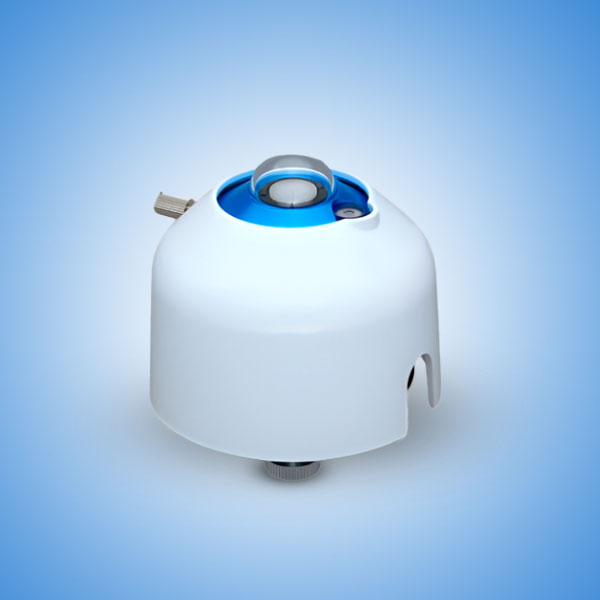
A pyranometer is a scientific instrument used to measure global solar radiation, also known as Global Horizontal Irradiance (GHI).
Unlike ordinary light sensors that measure brightness, a pyranometer measures the total solar energy falling on a horizontal surface. This includes:
The measured solar irradiance is typically expressed in watts per square metre (W/m²), making it one of the most important environmental parameters in renewable energy, meteorology, agriculture, and climate science.
The primary purpose of a pyranometer is to provide accurate and continuous measurements of solar radiation.
This data helps organisations understand how much solar energy is available at a specific location, allowing them to monitor environmental conditions, evaluate system performance, improve weather analysis, and make data-driven decisions.
Rather than estimating sunlight based on weather conditions, a pyranometer provides actual irradiance measurements, which are far more reliable for professional applications.
Many industries depend on accurate solar radiation data every day, often without people realising it.
A photovoltaic system converts sunlight into electricity. If the available solar radiation is unknown, it becomes difficult to determine whether reduced energy production is caused by weather conditions or by an equipment fault.
Solar radiation influences atmospheric temperature, cloud formation, evaporation, and weather patterns. Accurate measurements improve forecasting models and meteorological observations.
Sunlight directly affects crop growth, photosynthesis, irrigation planning, and evapotranspiration. Farmers and agricultural researchers use solar radiation data to optimise farming practices.
Scientists monitor long-term solar radiation trends to study climate variability, atmospheric behaviour, and environmental changes.
In every case, reliable decisions begin with reliable measurements.
A pyranometer continuously measures the solar energy reaching its sensing surface throughout the day.
The sensor captures both direct and diffuse radiation from the entire sky hemisphere. This energy is converted into an electrical signal, which is then processed by a data logger or weather monitoring system to calculate solar irradiance.
The recorded values can be viewed in real time through SCADA systems, cloud platforms, or dedicated weather monitoring software, while also being stored for historical analysis and reporting.
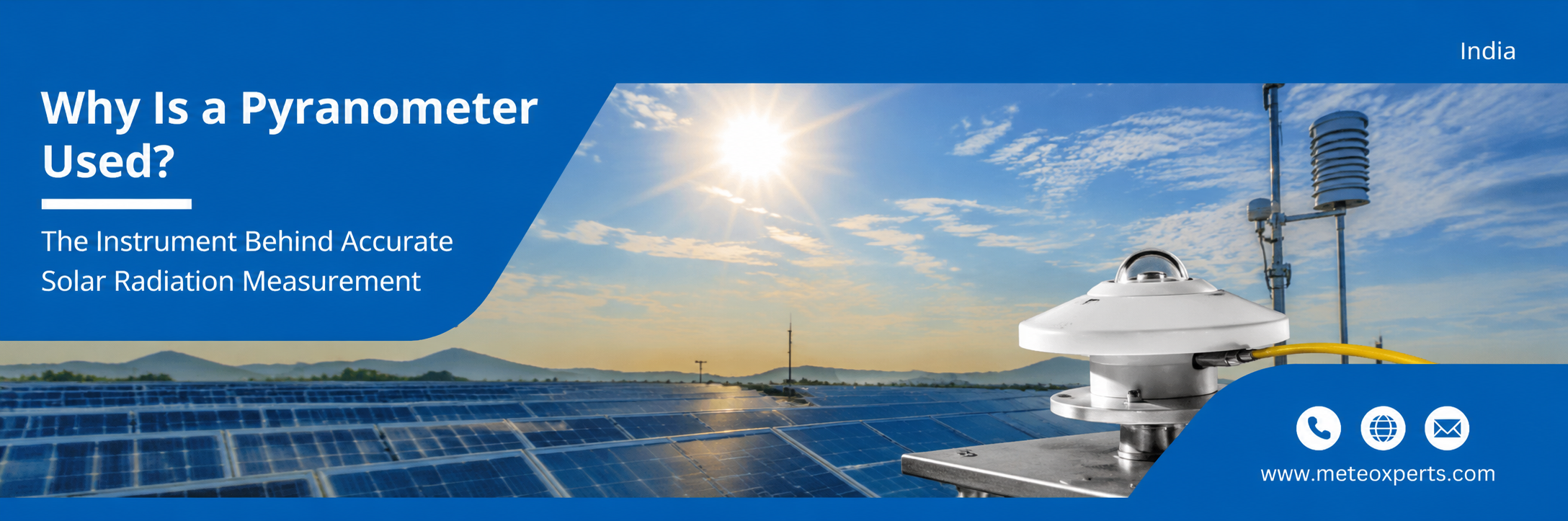
Solar developers use pyranometers to evaluate photovoltaic performance, calculate the Performance Ratio (PR), verify energy generation, and improve production forecasting.
Professional Automatic Weather Stations integrate pyranometers with sensors for temperature, humidity, rainfall, wind speed, wind direction, and atmospheric pressure to provide comprehensive environmental monitoring.
National weather agencies use pyranometers to monitor solar radiation for weather forecasting, climate observation, and environmental reporting.
Solar radiation measurements help researchers understand crop development, greenhouse conditions, irrigation scheduling, and evapotranspiration.
Pyranometers are widely used for renewable energy research, atmospheric science, climate modelling, and environmental studies.
Whether you're planning a new solar project or upgrading an existing weather monitoring system, choosing the right pyranometer is essential for accurate, reliable solar radiation data. Meteoxperts Solutions provides a pyranometer online at an affordable price in India for renewable energy, meteorological, agricultural, and environmental monitoring applications. Our range includes models such as the R-Si Photodiode Pyranometer for reliable solar irradiance measurement and the SMP Series Pyranometers (SMP3, SMP6, SMP10, and SMP12) for projects requiring high accuracy and long-term stability. Our technical team can also help you select the most suitable pyranometer based on your monitoring requirements.
Many organisations assume that weather forecasts or nearby weather stations provide sufficient solar radiation information. However, solar irradiance can vary significantly even across short distances due to cloud cover, terrain, and local environmental conditions.
Without on-site solar radiation measurements, organisations may face:
For professional applications, direct measurement is always more dependable than estimation.
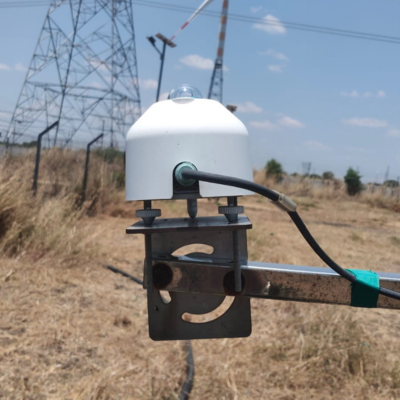
Even a high-quality pyranometer requires proper installation and maintenance to deliver reliable data. Some of the most common causes of inaccurate measurements include:
Expert Insight: In dusty environments such as solar farms, even a thin layer of dirt on the pyranometer dome can reduce measurement accuracy. Regular cleaning and scheduled calibration are simple practices that help maintain reliable long-term data.
This is one of the most common misconceptions.
The answer is no.
A lux meter measures illuminance, which represents how bright light appears to the human eye and is expressed in lux (lx).
A pyranometer measures solar irradiance, which represents the actual solar energy reaching a surface and is expressed in watts per square metre (W/m²).
Although both instruments measure light-related parameters, they serve completely different purposes and cannot be used interchangeably.
Using a professional pyranometer provides several practical advantages:
A pyranometer is much more than a sensor that measures sunlight. It is a precision instrument that provides the accurate solar radiation data needed for renewable energy, weather monitoring, agriculture, scientific research, and environmental analysis. By delivering reliable irradiance measurements, it enables organisations to improve operational efficiency, validate system performance, and make informed decisions based on real environmental conditions.
As industries continue to rely on data-driven operations, the importance of accurate solar radiation measurement will only continue to grow.
Read More:
CEA Guidelines for Automatic Weather Station
Successfully installed an Weather Station
A pyranometer measures solar radiation. Air temperature is measured using a separate temperature sensor.
While requirements vary by project, pyranometers are widely used in utility-scale solar power plants and professional PV monitoring systems because they provide the irradiance data needed for performance evaluation and energy forecasting.
Yes. A pyranometer can operate independently when connected to a compatible data logger or monitoring system. It can also be integrated into an Automatic Weather Station for comprehensive environmental monitoring.
Calibration intervals depend on the manufacturer and the application's accuracy requirements. Following the manufacturer's recommended calibration schedule helps maintain reliable long-term performance.